CURRENT MUSINGS // FALL'25

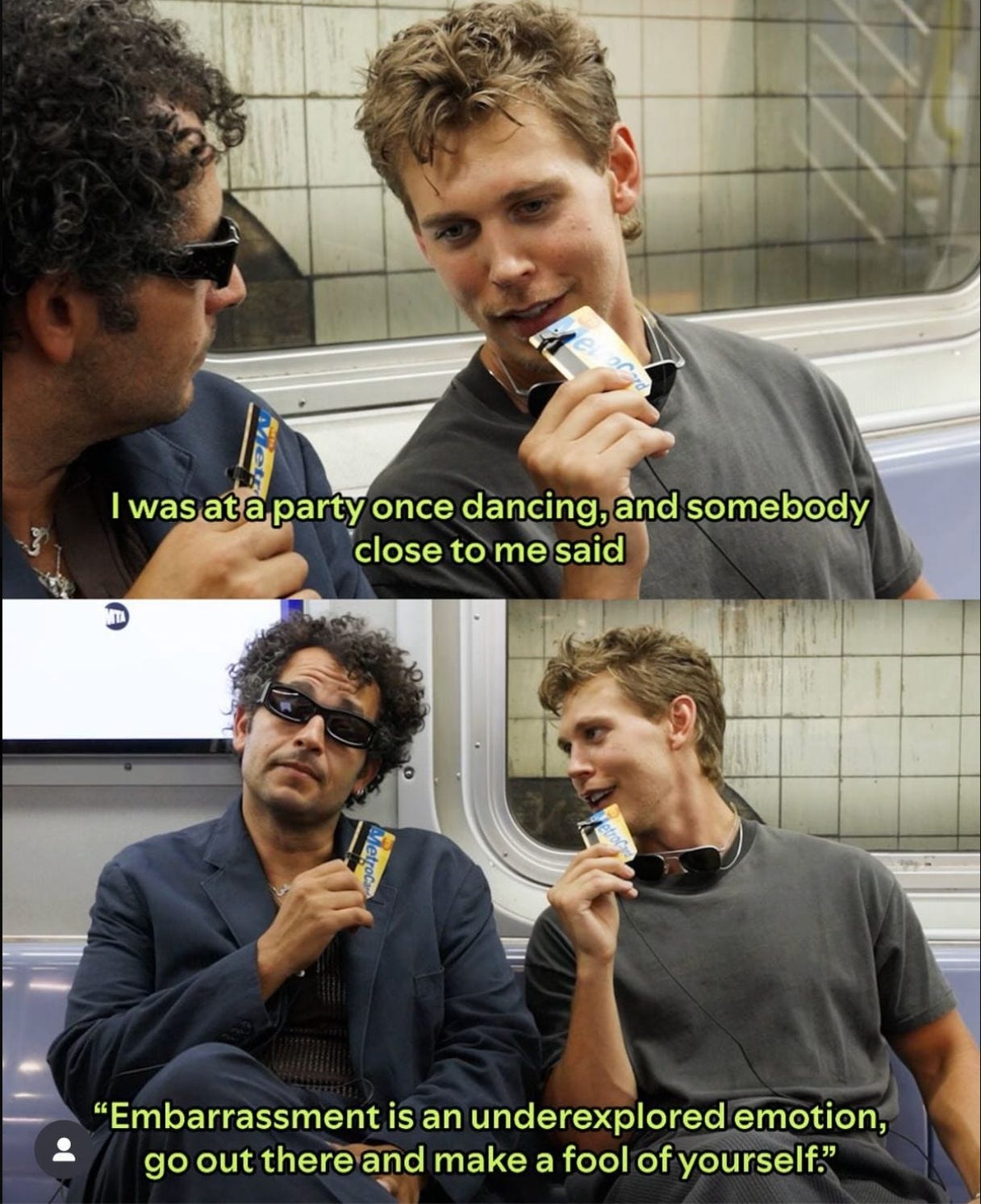
DAE think in proverbs? They repeat and refract, and I find myself pressing them onto everything I encounter to see what sticks. It’s like a chapter, a song, a seasonal theme—the lens through which I perceive the world for a week, a month, a year. Is this a shared experience?
Here’s what’s swirling (and sticking) lately.
1. Everything you want is on the other side of fear
This saying (often attributed to Jack Canfield) has been rattling around my brain. The idea: fear is the main barrier between us and what we want—new opportunities, meaningful relationships, growth, success. Push through the discomfort, take the risk, and often what you were looking for was waiting there all along. The line’s usually read as a call to hustle—kick down the door and claim your prize.
Though recently, I’m hearing it differently: maybe the thing waiting beyond fear isn’t what you want, but who you are once wanting loosens its grip.
Every wisdom tradition warns that real presence starts where control ends—Moses before the fire, Siddhartha under the tree, Frodo leaving the Shire in The Lord of the Rings. Anyone facing the unknown long enough to let it change them. Fear isn’t an obstacle so much as an initiation; what’s across the threshold is not comfort, but transformation. This is why encounters with the divine begin with “fear not” because experiencing presence—whether God, truth, or your own soul—requires moving past terror of the unknown, the holy, the loss of control.
I’ve been testing if the “everything you want” might be better translated as “everything you were created for” or “everything your soul truly needs”—which often looks different from what you initially thought you wanted.
1b. Faith and doubt are two sides of the same coin
From Bear Grylls. For later: add The Greatest Story Ever Told to the reading list.
2. Pathology as a heuristic
Jordan Peterson once said something like: You know a family system is pathological when the rules that apply within it don’t suit the outside world—aren’t iterable, can’t scale beyond the four walls.
I’ve been using this as a heuristic to identify whether something is healthy. Any microcosm—a company culture, a friend group, a personal habit pattern. If the logic can’t withstand contact with reality, it’s probably dysfunction masquerading as intimacy.
3. Trains
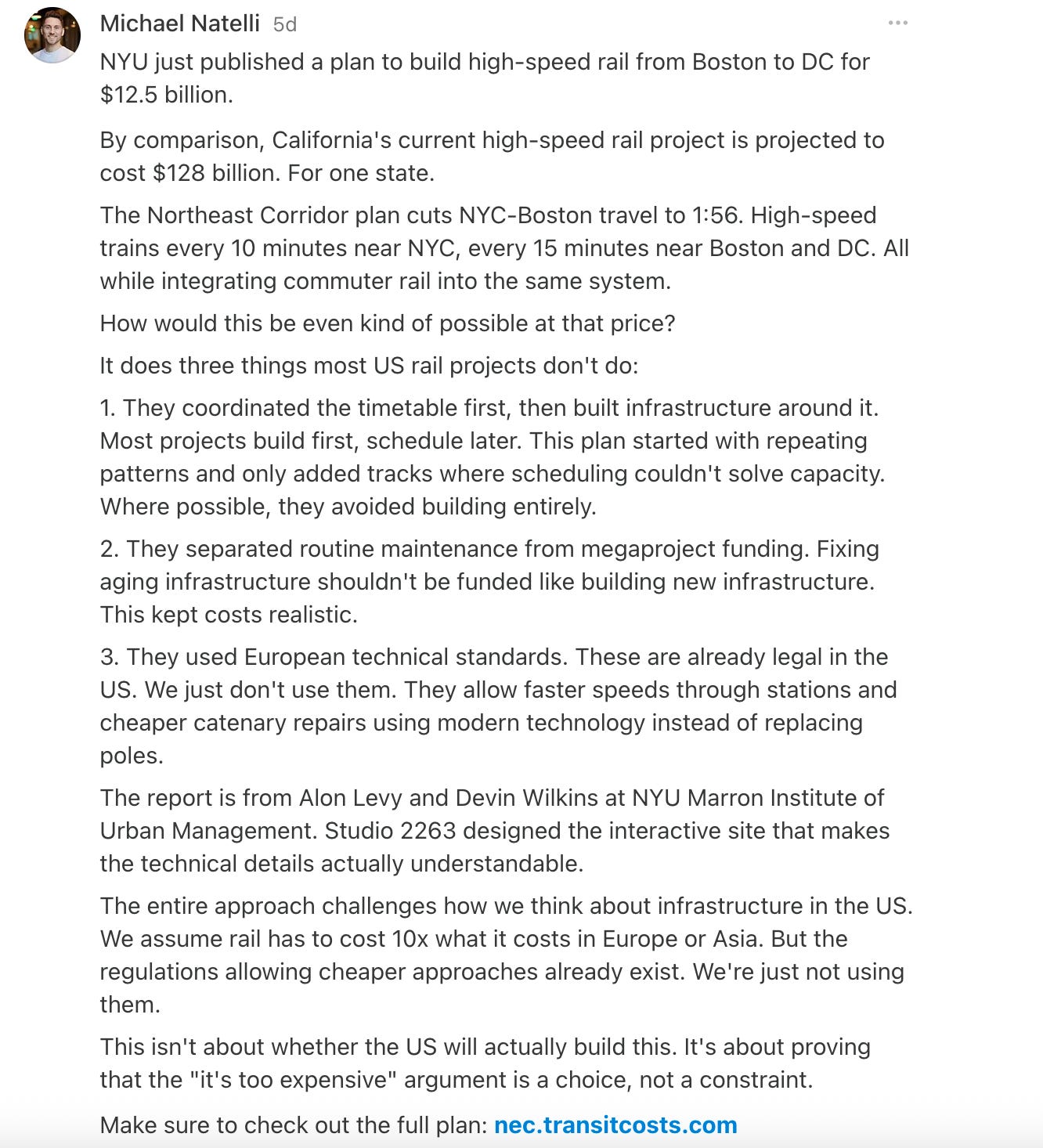
It’s my life’s goal to see a high-speed rail connect the US in my lifetime. That’s it. That’s the bullet point.

4. The resurgence of faith, MAHA, conspiracies, and longevity are all interconnected
The resurgence of faith, the longevity obsession, the MAHA crowd, the conspiratorial corners of the internet—different costumes, same hunger.
I’m watching these cultural threads braid together in real-time. The hunger for transcendence. The distrust of institutions. The obsession with optimization and immortality. They’re all expressions of the same spiritual crisis: a search for meaning in a world that promised progress but delivered fragmentation. People are reaching for transcendence in a world that feels both over-explained and under-understood.
Progress promised meaning; efficiency delivered fragmentation.
We’re all trying to re-enchant the world with whatever tools are left.
More on this at a later date. Still marinating.
5. The more things change, the more they stay the same
There’s an old French saying: plus ça change, plus c’est la même chose. Ecclesiastes put it this way: “What has been will be again, what has been done will be done again; there is nothing new under the sun.”
History and human experience are deeply cyclical. We think our era is unprecedented, yet we’re always retracing the footsteps of those before us. In venture, this shows up constantly—technology evolves at breakneck speed, but the core principles of building remain constant. Product-market fit. Earning trust. Team dynamics. Capital discipline. The context changes; the essence doesn’t.
This cyclical nature shatters the false understanding of maturity most of us carry. We presume progress is linear—that once we overcome a hurdle, we’ve transcended it for good. But life has a way of humbling us. The same challenges resurface in new guises. A leader who conquered ego faces a new success that tempts arrogance. Someone who outgrew insecurity encounters a new vulnerability.
Consider Jeff Booth and BuildDirect: after early struggles and rapid growth, the team felt “invincible.” Success bred overconfidence. When 2008 hit, their hubris collapsed along with revenue. Booth later reflected: “The same confidence that helped launch my company nearly killed it. It took a near disaster for me to re-learn how to be humble again.” He calls it the “cycle of arrogance and humility” that even the best entrepreneurs struggle to time correctly.
Consider how we’re all studying past bubbles but refusing to fully identify that we’re in an AI bubble right now.
True maturity isn’t a straight line out of struggle—it’s a widening circle of understanding. With each pass through a familiar challenge, if we’re wise, we gain perspective and compassion. Socrates was wise because he knew how much he didn’t know. Growth is ongoing. “Arrival” is a myth.
True maturity isn’t linear. It’s spiral. ;)
Each return to an old lesson offers a wider vantage point, a softer judgment.
6. We are only oppressed by the things we do not understand
Hosea 4:6: “My people are destroyed for lack of knowledge.” Ignorance can be its own form of oppression.
The Stoics said it differently: “People are not disturbed by things, but by the view they take of them” (Epictetus). It’s not external events but our perception and understanding that determine impact. When we lack understanding, the unknown looms larger, breeding fear and powerlessness.
Knowledge—especially self-knowledge and truth—breaks chains of fear and confusion. Even Christ taught this: “You will know the truth, and the truth will set you free.”
6b. To understand, do.
I got this from Huberman.
One of the surest paths to understanding is through action. Confucius: “I hear and I forget. I see and I remember. I do and I understand.” Aristotle echoed this centuries later: “For the things we have to learn before we can do them, we learn by doing them.”
Active participation transforms unknowns into knowns. If a concept oppresses you with confusion or fear, the remedy is often to roll up your sleeves and engage. A first-time founder might feel overwhelmed by launching a startup—reading provides some knowledge, but actually building, talking to users, iterating teaches far more. Theory alone can’t substitute for clarity gained through action.
By doing, we convert theoretical understanding into embodied understanding. The things that once oppressed us with uncertainty become familiar challenges we know how to approach. And importantly, this process humbles us—we realize understanding isn’t a one-time achievement but an ongoing practice.
This is where the cyclical nature of life meets the humility it demands. When we embrace that we’re not above recurring struggles, it fosters empathy. We become far less inclined to judge others harshly because we recognize our own continuing vulnerability. The hurdles that oppress others might once have oppressed us—and could oppress us again.
6c. We like to put things in a box but love doesn’t live in a box. Choose love over stoicism
First sentence is also from Grylls.
There’s a version of wisdom that armors itself in detachment—”nothing surprises me anymore.”
But real understanding re-sensitizes.
Simone Weil called attention the purest form of generosity: to see someone clearly is to love them.
In leadership, friendship, venture, or faith, the work is the same—hold up a mirror steady enough that another can see themselves without distortion.
Love is just understanding, embodied.
Faced with repetitive trials, one might retreat into stoicism or apathy. If nothing changes, why care? But authentic understanding should lead to compassion, not dispassion. When we truly understand our own struggles and how they echo in others, we’re moved to respond with love.
The highest teaching across traditions is often to love. Not superficial niceness or enabling, but caring enough to be honest and kind. “Speaking the truth in love”—patiently guiding someone toward truth while assuring them of their value. Being a mirror: reflecting the person back to themselves as objectively as possible, stripped of the distortions of circumstance and ego, so they can see a way forward.
The loop of understanding: Ignorance births oppression. Doing births understanding. Understanding births humility. Humility births love. Then the cycle begins again.
You meet someone who reminds you of your younger self. You love them enough to tell them the truth. You watch them fall and rise, and in their journey, you glimpse your own recurring lessons. You realize knowing isn’t the end but the beginning of freedom—and that the purpose of freedom is service.
7. Ariana Grande and Cynthia Erivo are my Roman Empire
I haven’t experienced fandom for anything like I have over Wicked since I was reading the Twilight series in elementary school. These women are women of craft, and witnessing them has been unexpectedly healing.
There’s something about watching two artists operate at that level of technical mastery while remaining so visibly human in their devotion to each other and the work. There’s so much legacy here. I have more thoughtful thoughts on this. Brewing.
8. New year, new me
Sent this title as a text to my best friend, Joanna, this week.
The cynicism around New Year’s resolutions exhausts me. So does my hunger for them. “You don’t need January to reinvent yourself.” Maybe not. But I like the permission. I’m taking it.
Related to: the more things change. Related to: we’re only oppressed by what we don’t understand. Related to: to understand, do.
This year’s resolutions: rejection-exposure therapy, more science fiction, less self-importance.
(Starting with Hitchhiker’s Guide to the Galaxy. Open to recs.)
Maybe this all has to do with working on making myself the protagonist of my story and daring to verge over my edge of fear.
Maturing is realizing all you need is to read more science fiction.